

A Closer Look at MSG
What it is, why it's added, and the controversy it sparks.
Welcome to our latest PrimaFoodie Ingredient Spotlight, where we investigate common food additives to understand their origins, uses, and purposes.
This week, we’re investigating MSG. It’s everywhere and commonly known. But what exactly is it?
What Is MSG?
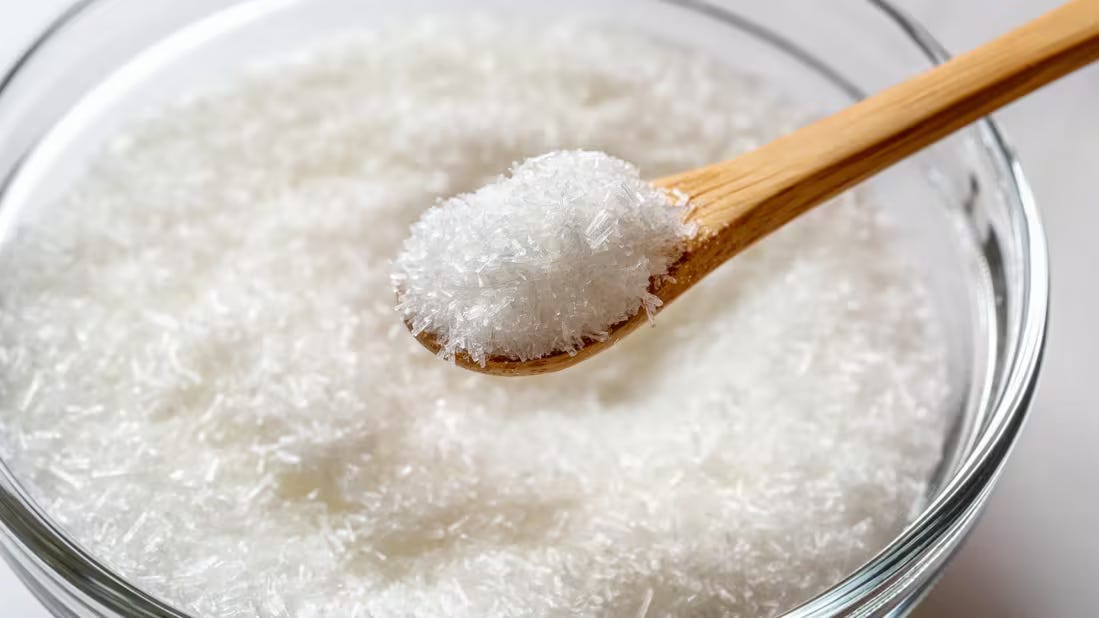
Monosodium glutamate, commonly known as MSG, is a food enhancer made of salt and glutamic acid. Glutamic acid is a naturally occurring, non-essential amino acid found in a range of umami-rich vegetables, fruits, and plants, including tomatoes, cheese, and mushrooms.
There are two schools of MSG: the kind that occurs naturally in many foods, and the kind that is created by a food manufacturer and added to foods. For this article, we’re looking at the latter.
How is MSG used?
MSG enhances a food’s flavor. For more than a century, chefs, home cooks, and restaurants have relied on this go-to crystalline additive for its ability to enhance richness and add umami.
When was MSG discovered?
In the early 20th century, Japanese chemist Kikunae Ikeda discovered that a certain kelp added a savory richness to his kelp soup. As he researched, he learned that it was the glutamic acid in the kelp that naturally brings out a food’s unique layers and flavors. Ikeda eventually found a way to extract and package the monosodium glutamate. Since then, it’s taken off commercially.
Where is it found?
MSG is added to countless—countless!—processed, ultra-processed, and packaged foods, most often without our knowledge. Some of these foods include:
Salad dressings
Condiments, such as ketchup and mustard
Marinades and seasonings
Spices
Fast food
Restaurant foods
Packaged soups
Movie popcorn
Frozen meals
Instant noodles
In the century-plus since MSG has been in existence, people have been eating it generously. The FDA deems it “GRAS”, which translates to “generally recognized as safe” for consumption, which is nebulous terminology that doesn’t necessarily determine if something is, in fact, safe for our health.
The FDA requires added MSG to be listed on ingredient lists.
Why is MSG controversial?
So, MSG is legal. But is it unhealthy? That’s a heated debate—and it’s why it can be controversial.
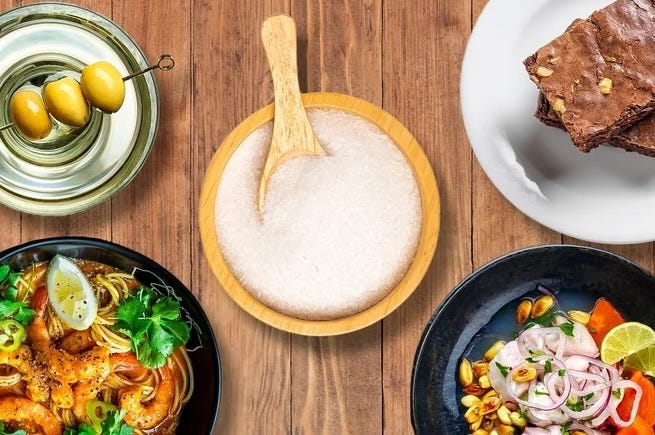
Around the 1960s, a strong campaign against MSG saturated media headlines, pointing the finger at Asian restaurants for adding lots of the ingredient to their dishes. People were claiming to have a “syndrome” that is caused by eating foods heavily seasoned with monosodium glutamate. These claims inspired advocates of the flavor enhancer to speak out in its favor. Many believe that MSG poses no threat to humans. MSG advocacy groups have sprouted, as have studies that show no direct link to health concerns.
On the other side, there are many who believe MSG to be a toxic additive that can be detrimental to our health. One study found MSG to potentially cause nerve and brain damage in laboratory animals.
Many people have found that consuming MSG can trigger a range of reactions, including sweating, chest pain, headaches, tingling, flushing, and numbness. Medical researchers in the field have referred to a host of reactions as the MSG System Complex.
The PrimaFoodie take on MSG.
Here’s what’s critical. Manufactured MSG is an additive. And, like any additive, it makes us pause. It may be okay for some to consume it in small amounts, but what happens when you eat it repeatedly? That’s what’s critical to consider: It can compound in our systems.
While naturally occurring MSG is just that, a naturally occurring substance in its organic form, when it’s extracted and manipulated in a food lab, it undergoes processing. And while it’s impossible to totally avoid processed foods these days, we aim to limit them as much as possible—and we aim to completely avoid ultra-processed foods.
Ultimately, what also concerns us is the limited research around MSG. The FDA may say it’s “generally safe,” but that gives us zero confidence that it’s truly okay. All of this is to say, it’s essential to read your labels and ask restaurants if they use it to stay aware of the amounts you’re consuming. Know what you’re eating.
And lastly, consider this: Why does a food truly need this additive at all?
That’s the question to ask.
Sources: